I would like to share with you one of my favorite scenes from my novel, A Beckoning Hellfire. This is the second book in the Renegade Series, which tells the story of several families and how their lives intertwine during the Civil War.
This excerpt takes place on June 4, 1863. A ball was held at Culpeper Court House, Virginia, days before the Battle of Brandy Station took place on June 9, 1863. (The court house is still there today.) The Battle of Brandy Station was the largest cavalry battle to ever take place on American soil. I hope you enjoy this trip back in time!
On the evening of June 4, Major Ivey Lewis ordered David to deliver a dispatch to General Stuart, which wasn’t unusual since he had been summoned as a courier several times during the past few weeks. Although he was physically tired and emotionally drained from a long week of drilling, he obediently stuck the sealed envelope in his pocket, saddled Renegade, and received directions to the Culpeper Court House.
Once he rode up, he was awestruck by the enchanting scene. Belles in beautiful ball gowns of every color stood out on the lawn with officers attired in dress uniforms. Lively music floated through the air. The song was “Cindy,” one of his favorites.
David couldn’t help but smile as he dismounted. “What’s all this?” he asked a servant, who took hold of Renegade’s reins.
“Massa Stuart’s havin’ a grand ball, suh,” the tall, bearded black man said. “He invited ladies from the whole vicinity. Most came by rail, all the way from Richmond.”
David raised his eyebrows and grinned at the slave. “Is that a fact?” he asked.
“Sho is.” The servant smiled with a nod before tying Renegade to a post.
With eager anticipation, David sauntered toward the courthouse entrance and absorbed the sumptuous sight. The grounds, illuminated with Chinese lanterns, invited him closer. Southern gentry milled around in the warm evening air, the hum of their genteel conversations filling his ears, along with the clink of goblets tapping together. The sky glittered with fireflies, and the lawn was swathed in candlelight. Another song commenced. David recognized that melody as well: “Cumberland Gap.”
He climbed the steps and entered the courthouse, immediately enthralled by what he saw. Couples in ballroom attire danced joyfully in the center of the room, swirling in time to the melody like wispy dandelion seeds floating in the breeze. Several musicians congregated together toward the back of the room, and they appeared to be enjoying themselves just as much. Chatter and laughter intermingled with their lively music. Chandeliers of flickering candles hung from the rafters, and the sweet scent of perfume drifted through the air.
David made his way through the crowd, suddenly mindful of how ordinary he looked. Bashfully, he smiled at the ladies, but they haughtily glanced over him before turning away toward their escorts. He noticed a table of wine, punch, and viands off to the side, which sparked his voracious appetite. The thought crossed his mind that perhaps he could sneak a few tidbits into his pockets on his way out. Spotting General Stuart, he made his way over to him.
“Sir,” he said with a salute.
The general turned from the belle he was conversing with, noticed David, and saluted back.
“I have orders to deliver this to you personally.” David handed him the envelope that had been sealed with wax.
“Very good, Private,” Stuart said.
The general didn’t seem to recognize him. Disappointed, David saluted again and awkwardly remained at General Stuart’s side, waiting for a response. Stuart turned away. Without knowing quite what to do next, David stood there for a few seconds before deciding he had been cold-shouldered, so he turned and made his way back toward the door.
He paused to watch the musicians, who were surrounded by admiring ladies. They stopped their performance momentarily, allowing for applause before proceeding to play “Ring, Ring the Banjo.” Two fiddlers enthusiastically sawed on their instruments. A dark-haired, mustachioed man plucked away on his banjo, and a mulatto servant smiled widely as he played the bones. David remembered what the other troopers had told him about General Stuart’s mulatto footman, Bob, and about the banjo player, Sam Sweeney, who was said to be the brother of the man who had invented the banjo. He also heard that General Stuart was a music lover who never missed an opportunity to be entertained by his musicians. If only they had a guitar, he might find the courage to go up there and sing alongside them, but his heart was too heavy for him to feel exuberant enough to sing. He wished Jake were there to see the grandiose scene. It was so dazzling that he felt like he was in a fairy tale.
He glanced around the room, reminded again of how out of place he was. The young ladies looked upon him with disdain, obviously repulsed by his shabby appearance. The musicians began to play “Cavalier’s Waltz,” prompting dancers to swirl around in synchronized whirlwinds. To his dismay, the food table was too far away for him to attempt thievery without being noticed, so he reluctantly turned and went outside. He met Colonel Von Borcke on the way out and discovered by standing next to him that the Prussian was enormous. The colonel recognized him immediately.
“I’m looking forward to racing your little horse!” he said, laughing as he walked into the courthouse.
David was left alone on the portico. Once again, he wished he could be a part of the celebration, but instead, he let out a sigh, climbed up on Renegade, and rode off into the darkness.
One hundred and sixty-two years ago this week, both Union and Confederate soldiers prepared for what would become one of the greatest battles in American history, the Battle of Gettysburg. This excerpt is from my novel, A Beckoning Hellfire, which is the second book in the Renegade Series. During this time, the Confederate cavalry was making its way north after engaging in the Battle of Brandy Station, which was the largest cavalry battle to ever take place on North American soil. This excerpt describes what General J.E.B. Stuart’s cavalry went through from June 24 through June 30, 1863.
Two days later, after being instructed to prepare three days rations, J.E.B. Stuart’s cavalry congregated in Salem, Virginia. General Stuart chose three brigades to travel with him: Hampton’s; Rooney Lee’s, now under Chambliss; and Fitzhugh Lee’s. Generals Jones and Robertson were to remain behind to guard the gaps in the Confederate army as they traveled through the Shenandoah.
Just after midnight, the troopers moved out, four abreast, riding through the cover of darkness.
“I’m tired as an old work mule,” John complained.
“I’m bored out of my gourd,” said Michael.
David was too tired to respond, and Renegade plodded wearily beneath him like he was in a trance.
They rode throughout the day and into the night. Just past midnight, word came down the line, passed from rider to rider.
“The Bluecoats are blockin’ the road ahead. We have to detour.”
The riders turned north toward Glasscock Gap in the Bull Run Mountains.
When morning sunlight finally penetrated the gap, they were traveling single file down a road no wider than a wagon. On each side, limestone rocks formed precipices of immense height. Trickling fountains sprung out from the crevices, and trees formed a dark canopy above them, so thick that rays of sunlight could only penetrate in a few places. The clatter of thousands of hooves, the creak of leather, and the clank of steel reverberated off the rocky walls. The thought crossed David’s mind that the narrow passage they were in could be a mighty tomb for all of them if the enemy trapped them in this unforgiving place, but he kept his horrible thoughts to himself.
They made their way through the gap, which took all morning. Around noon, they encountered Yankee infantry, so they fired at the Federal soldiers who marched by. The column of passing footmen was massive, spreading from north to south as far as the eye could see.
Scouts reported that every road in the area was filled with marching Union soldiers. With no other recourse, General Stuart decided to fall back into the mountains for the night.
Rain fell throughout the following day. The Rebel troopers circled southeast and found a clear path near Fairfax Court House, where “Fighting” Joe Hooker’s Union headquarters had recently been located. That night, they camped southwest of the courthouse.
David was called to picket duty once again, so he dutifully mounted up. Riding out into the darkness, he heard a fiddler softly playing “All Quiet Along the Potomac Tonight.” The song, about the death of a picket, caused a chill to run down his spine.
Riding far from camp, he met up with a few other pickets. Soon, he wandered away and came to an appropriate, lone position.
“Whoa,” he said in a low, soft voice.
He gently pulled back on Renegade’s reins. A cool breeze rustled through the trees. The moon above cast long, dark shadows across the ground. It was deathly quiet; not even a cricket chirped.
David shivered. Deciding to move around for warmth, he slid from the saddle, but stumbled in the dark. He noticed a round white rock, so he knelt down and picked it up. Oddly, it was much lighter than a rock. He turned it in his hands. Empty eye sockets bore into him, and the bony teeth grinned at him from death. Impulsively, he screamed and tossed the human skull away in panic, which sent it flying over the field. Horrified, he suddenly became aware his surroundings.
Long white bones stuck out from mounds of dirt that at one point must have served as makeshift graves. Weathered woolen uniforms and knapsacks, still intact, clung to the skeletal remains. Cannonballs sat scattered about, an eerie reminder of what had happened here.
Realizing he was in a terrible graveyard, he shuddered. For some reason, the Yankee whose head he’d lopped off popped into his head. He glanced around, expecting the headless soldier to ride out of the darkness and attack him. An owl hooted. David nearly jumped out of his skin. Anxious to depart the frightening scene, he hurried back to Renegade, mounted, and prompted his colt to trot.
For the rest of the night, David walked Renegade along the side of a road and carefully avoided the horrible scene of death. He had no need for coffee. His fright kept him wide awake.
When he returned to camp the next morning, he told Custis what he’d seen, and how he had held a dead man’s skull in his hand, just like in a scene from Hamlet.
“Oh, that must be what’s left of those poor fellers who fought over yonder last year. We’re right close to Manassas. You didn’t know that, did you, Summers?”
Wide-eyed, David shook his head.
Custis giggled. “Reckon you got a good scare, then!” He guffawed.
David scowled and strode away. He wanted to get some sleep before the orders were given to march again, so he managed to doze for a few hours before the alert came through the camp to proceed north.
General Hampton’s brigade led the way toward Fairfax Station. General Stuart, in his usual regal grandeur, galloped past them. He soon returned, ordering a charge, and the cavaliers followed their “Beau Sabreur” with unquestioning devotion. They encountered a Yankee detachment of cavalry and captured the entire regiment. Learning the Bluebellies hailed from New York, David asked one of his captives what the state was like.
“It’s the most beautiful place you’d ever care to see,” the Yankee informed him. “The trees turn the brightest colors in autumn, and the girls are all pretty and eager to keep you warm during the cold winter months!” The young man in blue smiled, seemingly unconcerned he was a prisoner, which caused his captors to scoff.
“Well, maybe I’ll git up there someday,” David said, “because I wouldn’t mind seein’ those pretty girls!”
They exchanged chuckles.
The captives were taken to the back but were later released on parole. David understood then why the Yankee soldier had been so unconcerned about his capture. He had known he wouldn’t be a prisoner for long.
The cavaliers rode to Fairfax Station. Upon arrival, they were allowed to help themselves to the abandoned sutlers’ shacks. In a flurry, they swarmed down on the goods and devoured them eagerly, indulging in ginger cakes, lobster salad, wine, ale, and whiskey while their horses grazed. It was the first real sustenance they’d consumed in quite some time, since both passing armies had already trampled and used up the land David and his comrades traveled over. The Rebel riders found gloves, hats, and shiny new boots as well, and immediately put them to use.
They resumed their march, continuing on into the night. Exhaustion forced them into more frequent stops and slowed their forward progress.
Around 3:00 a.m., they reached the Potomac River, crossing at Rowser’s Ford. The wide, ominous river roared at them.
“Gentlemen,” one of the officers commanded. “Dismount and lead your animals across.”
The horsemen obeyed. They waded out into the black water. David did the same, but as soon as he set foot in the rushing water, shockwaves ran through him. The icy water was much colder and deeper than he had imagined. Mimicking the other troopers, he held his ammunition above his head while he made his way across. The water threatened to rush up over his shoulders. He glanced back at Renegade, who held is head high to avoid the water. One man ahead of David was nearly swept away by the current, but he managed to free himself and get across. Some of the mules brayed in complaint but quieted under the roar of the rushing water. Finally, David reached the opposite bank and struggled to keep his footing. He comforted Renegade, and wondered if either one of them could endure much more. Shivering, drenched and dripping, he watched the rest of the cavalry follow. Braying mules lurched and strained. Some were nearly pulled into the current. The ambulances, after much difficulty, lumbered across. The guns almost went beneath the water, but the mules managed to pull the heavy artillery up and through the river. Amazingly, after over an hour, Hampton’s brigade succeeded in crossing the wide river without any loss of men or munitions.
The troopers were now in Maryland, on Yankee soil. Following orders, they burned barges and mutilated boats. David didn’t mind, since they belonged to the Yankees. The men set about their destructive task with all seriousness, for they knew they could be attacked at any moment. After they carried out their orders, they were allowed to sleep for a few hours before resuming their march.
While they traveled, the commanding officers passed the word to be on the lookout for free and escaped slaves, and to capture blacks they came across. Freedmen, or contraband, were to be returned to slavery. In accordance with President Davis’ declaration on May 1, several weeks before, black soldiers who were caught fighting for the Union side were to be taken as prisoners of war. The declaration authorized their punishment; even their deaths.
The Confederates rode into Maryland. Along the route, they pillaged fields and knocked down telegraphic links connecting the army with the capital. They came upon the Chesapeake and Ohio Canal, and wrought as much damage to it as they possibly could. A few hours later, they tore up the Baltimore and Ohio rail line leading to Frederick. By mid-afternoon, they passed through Williamsport, and captured several wagons and teams from the enemy they encountered.
They reached Rockville. This being Sunday, the townsfolk were dressed in their church-going finery. As the cavalry proceeded through, sympathizers to the Southern cause waved Confederate flags and cheered from upper windows and side streets. Hampton’s brigade came upon an all-girl seminary. David and his comrades found themselves immediately surrounded by pretty young ladies in brightly-colored dresses. The cavaliers graciously accepted the girls’ admiring glances. Many of the young women waved small, improvised Confederate flags, sheet music, and handkerchiefs, while others requested souvenir buttons from the soldiers’ uniforms.
The butternut coat David wore wasn’t equipped with elaborate brass buttons. Disappointed none of the fair maidens noticed him, he could only watch while they chatted, flirted, and pinned ribbons on the uniformed troopers while asking where they were from. Some of the horse soldiers exaggerated, claiming to be from various Southern states, thus convincing the young ladies that they represented every state in the Confederacy.
A girl in a lavender cotton dress with purple ribbons in her long, dark brown hair walked over to David.
“We are so very proud of you boys,” she said, flashing a smile so radiant his heart melted.
Returning a shy smile, he replied, “Why, thank you, miss.”
Custis and John snickered, amused by his reaction.
The girl held her hand up to him. “My name’s Rebecca. Pleased to make your acquaintance.”
He hesitated for a moment, then gently took her hand and kissed the back of it. “I’m David,” he half-whispered, causing his comrades to chuckle even louder.
“I was wonderin’, Mr. David, if you’d be so kind as to cut me off a piece of your hair.”
He gave her a questioning look.
“As a memento, of course,” she added. She brought her other hand from behind her back and handed him a pair of scissors.
Remembering the character from Ivanhoe of the same name, he wondered if this Rebecca was also a sorceress, and what intentions or spells she had in store for his hair. He could certainly see how brave men would fight for her honor. Grinning bashfully, he took the scissors from her and politely snipped off a lock.
As though reading David’s thoughts, Custis asked Rebecca, “Whatcha fixin’ to do with it?”
Rebecca looked over at him, still smiling. Custis’ quizzical expression faded, and a slight, enchanted smile crossed his lips.
“Why, I do believe I’ll make a bouquet with it, frame it, and hang it up in my bed chamber.”
John raised his eyebrows, the corners of his mouth curling beneath his beard. He and Custis both looked at David, as did Rebecca, who flashed her same disarming smile at him. David could feel his face blushing. Once again, the other two soldiers chuckled at his reaction.
“Thank you kindly, dear David,” Rebecca said. She handed him a sweet before pursuing another long-haired cavalier.
David sat stunned atop Renegade. For a moment, he couldn’t hear anything but his own heart thumping in his ears. A trooper from the 2nd South Carolina rode in, bringing David back to reality.
“There’s a supply train comin’ this way,” the trooper alerted them. “Sent from Washin’ton City. We reckon it’s intended for Hooker’s army.”
The horsemen quickly pulled themselves away from their admirers and spurred after their quarry. It wasn’t long before they caught up to the wagon train. Hungrily anticipating a feast, they whooped, screamed, and gave the Rebel yell. The surprised Union teamsters started to flee in panic. Some turned off onto side roads, while others at the end of the wagon train quickly reeled around and thundered back toward the capital. The raiders descended upon the frightened wagon masters, kicking up dust as they ran. They slashed their reins, produced pistols, and proceeded to gun down the teams and drivers, whose terrified mules galloped with such fury that the teamsters lost control. As a result, their wagons overturned, spilling their contents and flipping the mules onto their backs. Other wagons behind them collided, causing a pileup, and making it much easier for the Rebels to surround and contain them. The teamsters ahead of the collision lashed their mules mercilessly and barreled back toward Washington, but the Confederate cavalrymen pursued.
As Renegade thundered ahead, David leaned down from the saddle and slammed the butt of his Enfield rifle on the ground to pack the powder, shooting at the retreating wagons as he came upright. Once again in the race, Renegade’s gait was quick and smooth. For a moment, David marveled at the phenomenon. It was almost as if his little horse could fly. He nearly caught up with the end wagon before reaching a ridge. Pulling back on the reins, David abruptly forced Renegade to stop. The wagons escaped and vanished down the road to the capital.
From the hillcrest, David and his fellow cavaliers could see the unfinished dome of the Capitol Building, and all of Washington City around it. They were too close to enemy territory. David made a sharp turn and galloped back to the captured wagons. The others followed. Troopers from Chambliss’ brigade were already raiding the wagons of ham, sugar, bread, bacon, and whiskey. David and his comrades managed to filch some of the ham before being run off.
Stuart’s cavalry proceeded to take inventory of the newly-acquired bounty. The U.S. Army wagons were brand new, the harnesses were in use for the very first time, and the mules were fat and sleek. Of the 150 wagons they had chased down, 125 of them had been captured, along with 900 mules and 400 teamsters.
The Yankees were paroled that evening and released after they vowed not to return to duty as Union soldiers. The Rebel troopers fed their own horses the oats they had obtained, righted overturned wagons, and burned damaged ones. At sundown, they resumed their march north, but constant drizzle, compounded by the added hindrance of their captured wagons, made the journey painfully slow. As the Rebels traveled twenty miles to Cooksville, exhaustion ate away at them.
“Destroy the enemy’s main war artery,” General Stuart commanded.
His cavaliers demolished six miles of track, rolling stock, and station buildings belonging to the Baltimore and Ohio Railroad. By the time they were finished, the oppressive summer heat bore down on them.
A train rumbled toward them. The troopers heard it and ran for their horses in hopes of capturing and destroying the engine, but the alert engineer noticed danger ahead of him, so he pulled on the brakes.
The locomotive screeched until it came to a halt. Reversing direction, it disappeared around a bend before the Rebels could catch up to it. Several other trains appeared, but those engineers also observed trouble and escaped.
The cavaliers continued on to Sykesville, where they burned a bridge and cut telegraph wires. They resumed their march, bivouacking that night near Westminster.
David shared the ham he had acquired with his messmates. While the men settled in, worn out and dusty, his mind began to wander. He thought of Jake, and how he would have reveled in the day’s excitement. Exchanging flirtations with the young women at the school would have delighted him, no doubt, and the Rebels’ merry chase in capturing the wagon train would have had him talking about it for days. Instead, David was alone with his feelings, for it was difficult to speak about personal things with his fellow troopers, even with John and Michael. It just wasn’t the same as confiding in his best friend. His heart ached with the realization Jake had been gone for nearly two months.
Pulling the pocket watch out, he clicked the cover open. There was Callie, staring back at him, radiant as ever. The sight of her face gave him some comfort. Hopefully, she was waiting for his return. He wondered if she had received his letter by now, informing her of Jake’s untimely death. He wished for some word from home, but knew it wasn’t likely to happen, since they were on the march. Lying down, he choked back sob, and closed his eyes. Exhaustion quickly overtook him.
Enter for your chance to win a free copy of my new book, Fool’s Gold Folly! I will be holding this contest for a week. All you have to do is shoot me an email with the word “contest” in the subject line. My email address is jdrhawkins@gmail.com. The winner will be announced next week. Good luck!
Four of my books, A Beautiful Glittering Lie, A Beckoning Hellfire, A Rebel Among Us, and Double-Edged Sword, are being featured in an article appearing on INSCMagazine. These are the first four books in the Renegade Series, which tell the story of a family from north Alabama and how the Civil War impacts them. Here is the link to that article:
Stay tuned for more news coming up! I’ll be working on a couple of podcasts next week, as well as more articles and features. Thank you all so very much for your ongoing support!
Mr. Davis was very fond of animals and birds. He always gathered the scraps from the breakfast table to feed his peafowls, and his dressing gown pockets were heavy with grain for his beautiful pets. He had a large flock of peafowls, of which he was very proud and fond. Every morning Mr. Davis would take his exercise on a short pavement leading from the back steps at Beauvoir.
“It is just the length of my exercise path in prison,” he would tell his friends.
Up and down, up and down this pavement he would walk, at his heels and all around him his flock of peafowls. One old cock especially would spread his gorgeous tail, droop his wings, and strut after Mr. Davis in the most comical fashion. Evidently, the bond of friendship between the two was a close one.
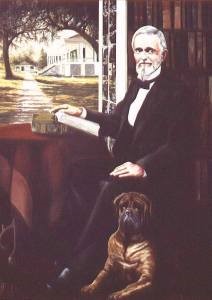
Fond as Mr. Davis was of his peafowls, his especial pet was his dog, Traveler, the same name as Robert E. Lee’s famous horse. This dog had a very wonderful history. Mr. (Samuel W.) Dorsey, husband of Mrs. Sarah Dorsey, from whom Mr. Davis purchased Beauvoir, had traveled all over the world. On the Bernise Alps, Mr. and Mrs. Dorsey purchased the young puppy, whose father was a Russian bulldog. The puppy was named Traveler. They carried the young dog everywhere with them, and he was trained to be Mrs. Dorsey’s bodyguard.
Once, while camping on the Arabian Desert, Mr. Dorsey had one of his Arabian servants punished severely for theft. The next day, Mr. Dorsey and some of the Arabians went on a two days’ journey, leaving Mrs. Dorsey and the camp in the charge of an old Arab sheik. That night, while asleep under the tent, Mrs. Dorsey was awakened by a spring and growl from Traveler, then the shriek of a man. She sprang from her cot, quickly got a light, and found the Arab who had been beaten by Mr. Dorsey’s orders pinned down to the ground by Traveler, a huge knife lying beside him, where it had fallen from his hand. He had cut his way into the tent and crept in, evidently determined to wreak his vengeance upon her for the stripes he received.
Mrs. Dorsey had magnificent diamonds, which she wore at night to a reception at the Tulleries. On her return to the hotel, she went at once to her room, while her husband and some friends walked out to smoke. She quickly went to sleep, but was aroused by a sound of a desperate struggle on the floor, where Traveler had succeeded in throwing the thief who had followed her, attracted by the glitter of her diamonds. This man was one of the worst characters in Paris, and the gallows were cheated when he died of the wound in his throat torn by Traveler’s teeth.
After Mr. Dorsey died, Traveler was given to Mr. Davis and became his constant companion and guard. He allowed no one to come on the place whose good intent he had any reason to suspect. The entire place was under his care; not a window or door was locked or barred, for everything was safe while Traveler kept his sentry march on the wide porches that surrounded the house on every side.
If Mr. Davis wished to safeguard their coming and going of anyone and give him the freedom of the place, day or night, he would put one hand on the person’s shoulder and the other on the dog’s head and say: “Traveler, this is my friend.”
The dog would accept the introduction very gravely, would smell his clothes and hands, and “size him up” generally; but he never forgot, and, henceforth, Mr. Davis’ “friend” was safe to come and go unmolested.
As fierce as the dog was, and as bloody as was his record, he was as gentle as a lamb with little children. Mrs. Davis’ small niece, a child about two years old, make the dog her chosen playmate, and the baby and the dog would roll together on the grass in highest glee. She would pull his hair, pound on his head, or ride around the place on his back, the dog trotting as sedately as a Shetland pony. This child lived some distance down the beach; but she went home day after day in perfect safety, guarded and guided by Traveler.
Traveler would rush around in hot pursuit of fiddler crabs, which was a pet diversion of his, and would bark and throw up the sand with his paws in wild glee when he had succeeded in driving a number of the ungainly objects into the sea. But even fiddler crabs had no attraction for Traveler when he went to walk with Mr. Davis. He was then a bodyguard, pure and simple, and had all the dignity and watchfulness of a squad of soldiers detailed as escorts. Mr. Davis would become buried in thought, almost oblivious to surroundings. Traveler had his own ideas of what was right and proper; so if in absorption Mr. Davis would walk very close to the water Traveler would gently take his trousers leg in his teeth, or, by bounding between him and the sea, he would manage to call attention to the big waves coming in.
One day, Traveler seemed very droopy and in pain. As ordinary measures did not relieve him, Mr. Davis wrote a note to a friend who was the most celebrated physician in that part of the country. The doctor came, but nothing seemed to relieve the dog’s suffering. All night he moaned and cried, looking up into Mr. Davis’s face with big, pathetic eyes, as if begging for help from the hand that had never before failed him. All those long hours, Mrs. Dorsey, Mr. Davis, and the doctor kept their hopeless watch, for the work of the vile poisoner had been too well done for remedy. Just at daylight he died, his head on Mr. Davis’ knee and his master’s tears falling like rain upon the faithful beast.
As Mr. Davis gently laid the dead dog upon the rug, he said softly: “I have indeed lost a friend.”
Traveler was put in a coffin-like box, and all the family were present at the funeral. Mr. Davis softly patted the box with his hand, then turned away before it was lowered into the ground. The dog was buried in the front yard of Beauvoir, and a small stone, beautifully engraved, marked the place, (but at some time during the intervening years, that stone has unfortunately disappeared) By: L. H. L. Excerpted from the Confederate Veteran Vol. XVII, No. 4, April, 1909
Thanks to: Sunny South News, Lowry Rifles Camp #1740 – Rankin County, Mississippi – Bill Hinson, Editor
I’m a big fan of critters. Right now, I have downsized to two dachshunds and two kitties. I also love horses but could never own one because we lived in the city. Some of my favorite memories, though, are when my sister and I went to my aunt and uncle’s farm during the summer and went horseback riding with our cousins. In fact, I adore horses so much that I wrote a book about them, titled Horses in Gray: Famous Confederate Warhorses. I felt like these magnificent beasts deserved to have their stories told rather than having them lost to history. I also love hearing about the pets that soldiers had during the Civil War. I’ll be sharing more stories about them in upcoming posts.
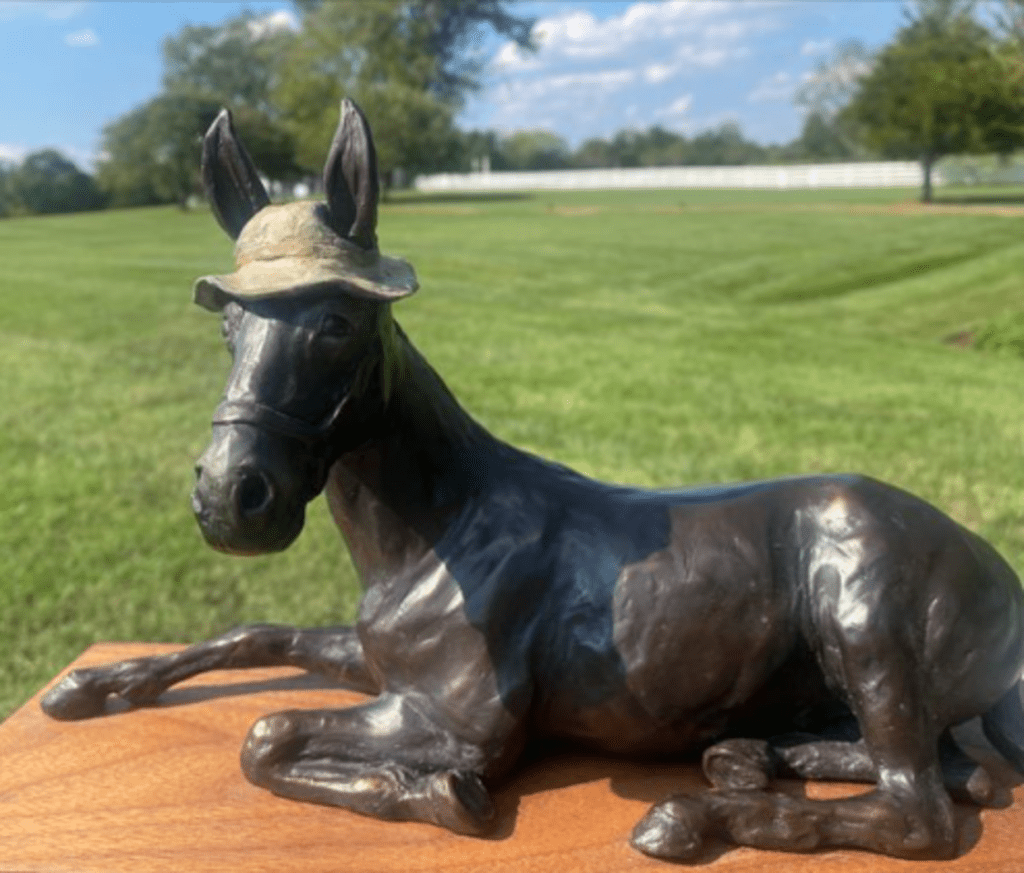
Meanwhile, I wanted to share this story about a mule who dutifully served with the 104 Ohio Volunteers, named May Me. She was so special that they have honored her with a statue!
Lt. Adam J. Weaver, 104th Ohio Volunteer, wrote to his wife between November 26 and the early morning of November 30, 1864, asking her to mark locations, times, and dates on a map he had sent earlier. He described the 6th Ohio placing a two-gun battery “pulled by mules, trained to lie down in action.” The lead mule, May Me, wore an old felt hat with holes cut for her ears.
In commemoration of this unique historical detail, the Battle of Franklin Trust has commissioned a life-sized bronze of May Me, the 6th Ohio Light Artillery’s leader mule.
With approval from the City of Franklin Arts Council, May Me will be placed in Carter Hill Park’s artillery display, enriching the site’s historical interpretation. Lieutenant Weaver’s account highlights the role of a single mule much like that of a soldier, offering a rare glimpse into the significance of animals in war. This documented detail from Franklin also invites exploration of battles like Stones River (December 31, 1862–January 2, 1863), where thousands of horses and mules perished.
If you would like to donate to the May Me the Mule project, gifts may be directed to The Battle of Franklin Trust, 1345 Eastern Flank Circle, Franklin, TN 37064. or online at https://boft.org/battlefield-reclamation.
(Article courtesy of Blue and Gray Education Society)
The Civil War was a time of unparalleled courage, sacrifice, and resilience. While much attention is given to the soldiers who fought bravely on the battlefield, it’s easy to overlook another group of heroes who played a crucial role in shaping history: the Confederate warhorses. These steadfast companions bore the weight of war—literally and figuratively—and their contributions were extraordinary.
More Than Just Mounts Confederate warhorses were far more than a means of transportation. They were indispensable partners in battle, carrying their riders into the chaos of war and back again. These animals endured grueling conditions, including hunger, exhaustion, and injury, while remaining loyal to their masters. The bond between soldiers and their horses was deeply personal. Many soldiers regarded their steeds as extensions of themselves, trusting them for survival and emotional support during one of the most challenging periods in American history.
“Horses in Gray”: A Legacy of Bravery The term “Horses in Gray: Famous Confederate Warhorses” doesn’t just refer to their role in the Confederate army and highlights their loyalty and valor. These warhorses often demonstrated incredible intelligence and bravery, navigating battlefields filled with cannon fire and chaos.
From leading cavalry charges to carrying messages across enemy lines, these horses were integral to the success of Confederate military operations. Without their unwavering service, many key battles might have ended differently.
The Emotional Connection What set Confederate warhorses apart wasn’t just their physical endurance and the deep emotional connection they shared with their riders. Soldiers often spoke of their horses with affection, recounting tales of loyalty and trust.
These animals weren’t seen as mere tools of war; they were companions who shared in the hardship and dangers of battle. For many, losing a horse was akin to losing a comrade. This bond underscored the unique relationship between humans and animals during adversity.
Sacrifices on the Battlefield The sacrifices made by these horses were staggering. They carried soldiers through treacherous terrain, stood firm under fire, and often paid the ultimate price. Yet, despite the dangers, these animals remained steadfast, demonstrating a courage that rivaled that of the soldiers they served.
It’s no wonder that the stories of “Horses in Gray: Famous Confederate Warhorses” continue to resonate. These tales remind us of the sacrifices made by humans and the animals who stood beside them.
Honoring Their Legacy Today, the contributions of Confederate warhorses serve as a poignant reminder of the unbreakable bond between humans and animals. Their stories highlight their vital role in one of the most tumultuous periods in American history.
By remembering these unsung heroes, we honor their sacrifices and the resilience and bravery that defined their legacy. Whether leading the charge or providing a moment of solace amidst the chaos, Confederate warhorses truly earned their place in history.
The next time you reflect on the Civil War, take a moment to consider the horses who gallantly carried their riders into the fray. Their loyalty, strength, and courage were as essential to the war effort as the soldiers they served, and their legacy lives on in the stories of Horses in Gray: Famous Confederate Warhorses.
For more information, check out my nonfiction book, Horses in Gray: Famous Confederate Warhorses, available on my website, jdrhawkins.com and amazon.com.
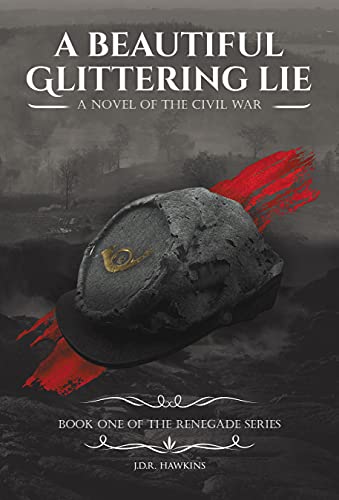
My novel, A Beautiful Glittering Lie, has received another five-star review. This book is the first one in the Renegade Series and tells the story of a family from north Alabama, and how the Civil War impacts their lives. Thank you so much, M. Kaye, for your review!
If you love authentic historical fiction, then J. Hawkins book will satisfy. The first book of the series explores the struggle of one family at the dawn of the civil war, detailing the rigors of maintaining the Homefront in the face of the missing Patriarch. It also examines David, son of the patriarch as he experiences coming of age while he grapples with the contradicting feelings of keeping his promise to his father and the family farm afloat or giving in to the rose-colored view of the war as an adventure and enlisting. While the first pages may prove difficult for some to get through as they detail a speech by Jefferson Davis, don’t let the first 7 pages deter you from this very worthwhile read.





 J.D.R. Hawkins

Leave a comment