Category: author

  • I’m Featured in Vanity Stardom

    I just received word that I am being featured in an article published in Vanity Stardom. This is a very flattering article, and I’m honored to be featured! Here is the article.

    J.D.R. Hawkins and the Human Story Behind the Renegade Series

    J.D.R. Hawkins brings the American Civil War to life through the Renegade Series, blending historical research, moral complexity and deeply human storytelling.

    Vanity StardomAuthor News

    Published 28 September 2026 at 19:50 IST8 min read

    J.D.R. Hawkins, author of the Renegade Series and Civil War historical fiction writer.
    Courtesy of J.D.R. Hawkins / Author’s official materials

    Key takeaways

    • J.D.R. Hawkins is the author of the four-book Renegade Series of Civil War historical fiction.
    • The series follows the Summers family through the Civil War and into the Reconstruction era.
    • Hawkins explores the conflict through a Southern and Confederate perspective while focusing on individual experiences and family relationships.
    • Her books combine historical research with fictional characters, battles, personal dilemmas and the consequences of war.
    • Hawkins has also written Horses in Gray: Famous Confederate Warhorses, a nonfiction work about horses during the Civil War.

    The American Civil War has been examined through history books, memoirs, biographies and countless works of fiction. Yet the subject continues to find new life in literature because the conflict was never only about battlefields and military campaigns. It was also about families separated by war, young people confronted with decisions they could not fully understand, communities transformed by violence and individuals trying to make sense of a country coming apart.

    For author J.D.R. Hawkins, those human experiences became the foundation for the Renegade Series, a four-book historical fiction saga that follows a family from north Alabama through the Civil War and into Reconstruction. Her work approaches the period through characters connected to the Confederate South, while keeping the consequences of war at the centre of the story.

    The result is a body of fiction that places historical events alongside personal relationships, difficult choices and the consequences that continue long after a battle has ended.

    Hawkins’ interest in the Civil War developed into a long-term writing project rather than a single novel. Her academic background in journalism at Iowa State University provided an early foundation for research and storytelling, while her broader writing career included work across short stories, articles and children’s literature before she turned increasingly toward historical fiction.

    The decision to write from a Southern perspective also gave the project a particular narrative challenge. The Civil War remains one of the most heavily examined periods in American history, and fictionalising it requires more than recreating uniforms, weapons and battle locations. Historical fiction has to make the period understandable through people. Hawkins’ books therefore use the experiences of individual characters to explore what a war of national consequence meant inside an ordinary family.

    That approach is evident from the beginning of the Renegade Series.

    The first novel, A Beautiful Glittering Lie, introduces the Summers family in north Alabama in 1861. Hiram Summers, a farmer and father, decides to enlist and eventually travels to Virginia with the Fourth Alabama Infantry Regiment. At home, his wife Caroline attempts to keep the family and farm together while their son David begins to confront the reality of a conflict that initially exists for him largely through stories, expectations and youthful curiosity.

    The novel’s focus on the Summers family allows the war to be seen from more than one location. Hiram experiences the conflict from the military front, while Caroline and the children experience its absence, uncertainty and consequences at home.

    That separation becomes an important element of Hawkins’ storytelling. War is not presented only through what happens when soldiers meet on a battlefield. It is also present in letters, waiting, fear, changing relationships and the difficult process of maintaining a household while someone is away fighting.

    The first book established the foundation for what would become a much larger family story. It also received recognition from historical-fiction organisations, including the B.R.A.G. Medallion and the John Esten Cooke Fiction Award. Hawkins’ official book information lists A Beautiful Glittering Lie as a winner of the 2013 John Esten Cooke Fiction Award and the B.R.A.G. Medallion.

    The series continued with A Beckoning Hellfire, taking its characters further into the realities of the conflict. The story becomes increasingly concerned with what combat does to individuals and how earlier decisions continue to shape the lives of those involved.

    David Summers becomes an especially important figure in that progression. His development is not simply the journey of a fictional soldier moving from one battle to another. His understanding of war changes as his experiences become more personal. The distance between youthful expectations and the reality of combat gradually disappears.

    With A Rebel Among Us, Hawkins moves further into the moral uncertainty created by war. David is seriously wounded and separated from the Confederate army following military campaigns, eventually finding himself at a farmhouse occupied by three sisters. His circumstances force him into choices that challenge the principles and loyalties that originally shaped his decision to fight.

    The premise allows Hawkins to explore one of the central characteristics of historical fiction: individuals rarely experience history in the neat categories that later generations use to describe it.

    David has to make decisions as a person rather than as a historical symbol. Loyalty, survival, family, personal principles and fear can pull in different directions. The official description of the novel centres on this dilemma, particularly the conflict between helping Anna and risking capture or remaining loyal to the reasons that brought him into the war.

    That emphasis on individual decisions is one of the distinguishing features of the series.

    Hawkins has described the Renegade books as a family saga as much as a war story. The four novels follow the Summers family across a much wider period than the opening months of the conflict, allowing the consequences of the Civil War to extend beyond the moment when fighting stops.

    That becomes especially important in Double-Edged Sword: A Novel of Reconstruction, the fourth major volume in the series. The story moves into the Reconstruction period, when the formal conflict has ended but the social and personal consequences remain.

    For a family that has spent years living through war, peace does not necessarily mean returning to the world that existed before 1861. The country has changed, communities have changed and individuals have changed. By extending the narrative into Reconstruction, Hawkins treats the aftermath as part of the historical story rather than simply an epilogue.

    The four novels therefore form a continuous arc. The opening book introduces a family entering an uncertain conflict. The following stories explore the physical and emotional consequences of that conflict, while the final volume examines what happens when the fighting is over but its effects remain.

    The historical research behind the novels is another significant part of Hawkins’ approach. Her work has been recognised for incorporating historical settings and events into character-driven storytelling. In discussing her research and setting choices, Hawkins has explained that the first Renegade novel moves between north Alabama and Virginia battlefields, using historically grounded locations to connect the fictional family with the wider events of the war.

    Reviews of A Beautiful Glittering Lie have similarly highlighted the combination of historical events and the Summers family’s personal story. Pacific Book Review noted the use of historical battles, events, songs and figures, while also describing the book as an intimate portrait of the family.

    This balance is central to why historical fiction continues to attract readers. Facts establish the world, but characters give readers a reason to remain inside it.

    Hawkins has also expanded her writing beyond the main Renegade novels. Her nonfiction book Horses in Gray: Famous Confederate Warhorses examines the role of horses during the Civil War, while A Becharmed Callie Christmas adds another story connected with the world of the series. Her current author catalogue also includes Fool’s Gold Folly, another story connected to her wider body of historical fiction.

    Her professional interests extend into several literary organisations, including the Historical Novel Society, International Women’s Writing Guild, Rocky Mountain Fiction Writers and Pikes Peak Writers. She is also associated with the United Daughters of the Confederacy and has pursued creative work outside fiction as an artist and singer/songwriter.

    The recognition surrounding the Renegade Series has also continued across multiple books. Hawkins’ official author materials identify the series as having received multiple John Esten Cooke Fiction Awards and B.R.A.G. Medallions, while the B.R.A.G. Medallion organisation lists the series and its individual books within its historical fiction catalogue.

    But awards are only one part of the story.

    What makes Hawkins’ work particularly notable is the decision to keep returning to a period that has already been extensively fictionalised and to look at it through a specific set of characters and circumstances. The Confederate perspective is an important part of the series, but the novels are ultimately structured around people rather than political arguments.

    That distinction matters when writing historical fiction about a conflict as deeply contested as the Civil War. A character can possess beliefs shaped by his time without the novel requiring readers to accept those beliefs as historical truth. Fiction can instead examine how those beliefs influenced decisions, relationships and consequences.

    In Hawkins’ case, that creates room for a story about the people who lived through the period without reducing them to simple categories.

    The Renegade Series asks readers to follow a family through uncertainty rather than simply follow a timeline of famous events. Battles matter, but so do the moments between them. The letters, the conversations, the separation from home and the decisions made under pressure provide the emotional structure of the story.

    That may be why the series has continued to find an audience among readers interested in Civil War fiction. Historical knowledge can tell us what happened. Fiction has the more intimate task of imagining what it might have felt like for individuals living through those events.

    For J.D.R. Hawkins, that distinction has shaped an entire literary career.

    Her work does not attempt to reduce the Civil War to a single experience. Instead, through the Summers family and the wider world of the Renegade Series, she has created a sustained fictional account of how war can enter a household, reshape relationships and continue affecting people long after the battlefield falls silent.

    The enduring appeal of the series lies in that human scale. The Civil War may have been a defining national conflict, but for the characters Hawkins writes about, it was also a collection of personal moments: a decision to enlist, a letter from home, a family waiting for someone who may never return, a young person discovering that war is different from what he imagined, and eventually the difficult task of rebuilding a life after the fighting ends.

    Through that lens, Hawkins continues to explore one of the most familiar periods in American history in a form that remains personal, character-driven and grounded in historical research. Her Renegade Series stands as an extended literary interpretation of the Civil War and Reconstruction, told through the experiences of a fictional Southern family whose lives are permanently altered by the events around them.

    J.D.R. Hawkins and the Renegade Series

    Amazon.com: J. D. R. Hawkins: books, biography, latest update
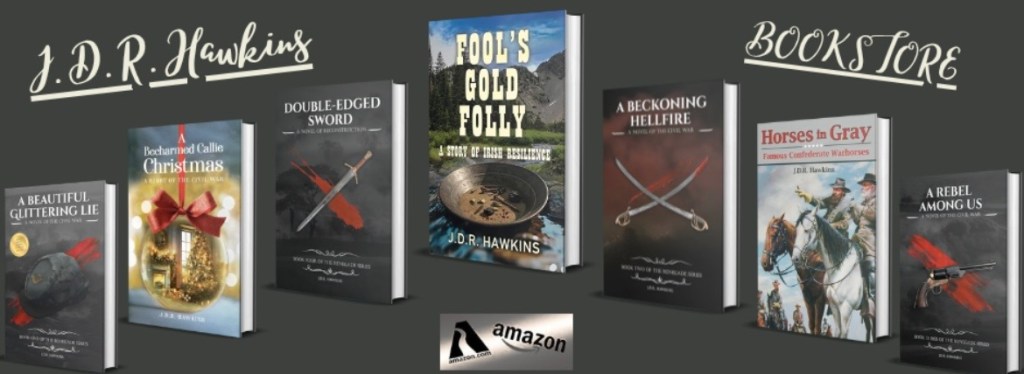
  • Featured in USA Today

    Last week, I was notified that I was featured in an article published by USA Today on September 4. I can’t express enough how flattered I am to be featured in such a prestigious publication! I have posted it here for your review. Let me know what you think! Thanks again for all your ongoing support!

    Where History Finds Its Human Voice: How J.D.R. Hawkins Turned America’s Most Divisive Era Into Award-Winning Fiction

    Updated Sept. 4, 2026, 8:16 a.m. ET

    History has never struggled to preserve dates. It remembers battles, treaties, political speeches, and the names etched into monuments. What history often leaves behind are the quieter stories, the families separated by conflict, the ordinary people forced to carry extraordinary burdens, and the moments between the headlines where fear, hope, and resilience truly lived. That space between documented fact and human experience is where historical fiction continues to prove its enduring value.

    Few periods challenge writers more than the American Civil War. More than a century and a half later, it remains one of the most examined chapters in American history, producing countless biographies, documentaries, and academic works. Yet writing fiction about the conflict demands something entirely different. It requires an author to respect history without becoming imprisoned by it, to balance research with imagination, and to create characters capable of making readers feel the weight of events they already know. The finest historical novels do not attempt to rewrite history. Instead, they restore humanity to it.

    That challenge has defined the literary career of J.D.R. Hawkins, an American author whose work has quietly earned a respected place within modern historical fiction. Through meticulous research, emotionally driven storytelling, and a willingness to explore perspectives that relatively few contemporary novelists choose to examine, Hawkins has built a body of work that extends beyond entertainment. Her novels invite readers to experience the Civil War not through generals or politicians, but through families whose lives were permanently altered by the nation’s defining conflict. In doing so, she has become one of the few female authors recognized for writing extensively from a Confederate perspective, while earning awards, bestseller recognition, and a loyal readership that continues to grow.

    A Writer Before She Ever Became an Author

    Long before her books appeared on bestseller lists or collected literary awards, Hawkins was simply a child fascinated by stories.

    Born on June 9, 1959, in Sioux City, Iowa, she discovered writing during elementary school, where stories became less of an assignment and more of an instinct. While many childhood interests disappear with age, this one never did. Encouraged by parents who valued education as much as creativity, she pursued both, eventually earning a Bachelor of Science in Journalism from Iowa State University.

    Journalism proved to be more than a degree. It shaped the discipline that would later define her novels. Reporters learn to verify facts before telling stories, and Hawkins carried that philosophy into fiction. Before writing novels, she experimented with short stories, magazine articles, and children’s literature, gradually developing a style that favored careful observation over dramatic excess.

    That patience would eventually become one of her greatest strengths. Rather than chasing publishing trends or writing across multiple commercial genres, Hawkins chose a path requiring years of historical research and remarkable attention to detail.

    Choosing the Hardest Story to Tell

    Historical fiction is demanding under any circumstance. Writing about the Civil War introduces another layer of complexity.

    Every battle, every political decision, and every social consequence continues to be debated today. Authors entering that space often face an impossible balancing act between historical accuracy and emotional storytelling. Hawkins approached the challenge differently. Instead of allowing politics to dominate her narratives, she placed ordinary lives at the center of extraordinary events.

    Her novels ask readers to consider not simply how wars are fought, but how families survive them.

    That perspective would eventually become the foundation of what is now recognized as her signature achievement.

    The Renegade Series: A Family Saga Woven Into American History

    Some authors become known for a single novel. Others build careers around a literary universe that grows richer with every installment.

    For Hawkins, that universe became the Renegade Series, an ambitious collection of novels following the journey of a Confederate cavalryman and his family through the Civil War and the difficult years that followed. Rather than presenting isolated adventures, the books function as an evolving family saga, allowing readers to witness not only the destruction of war but also the emotional cost carried long after the fighting ends.

    The series opened with A Beautiful Glittering Lie , a novel that immediately established Hawkins’ commitment to historical authenticity. Instead of treating the Civil War as a sequence of famous battles, the story narrowed its focus to people whose names never appeared in history books but whose struggles reflected those of thousands of real families. The novel resonated with both readers and literary judges, earning the 2013 John Esten Cooke Fiction Award and the 2012 B.R.A.G. Medallion, recognition that positioned Hawkins as an emerging voice within historical fiction.

    Rather than viewing that success as a conclusion, Hawkins expanded the story with A Beckoning Hellfire, where the realities of war deepen and the emotional stakes become increasingly personal. The novel further strengthened the series’ reputation, later receiving another B.R.A.G. Medallion while demonstrating Hawkins’ ability to sustain both historical depth and narrative momentum.

    The third installment, A Rebel Among Us, continued exploring the conflict through the eyes of individuals whose personal convictions collided with national upheaval. The novel earned the 2017 John Esten Cooke Fiction Award and the B.R.A.G. Medallion, reinforcing Hawkins’ growing reputation for combining historical precision with compelling character development.

    The journey continued beyond the battlefield with Double-Edged Sword: A Novel of Reconstruction, perhaps the series’ most ambitious chapter. Reconstruction remains one of the least understood yet most transformative periods in American history, and Hawkins shifts her attention toward the uncertain future awaiting families after the war had officially ended. The novel received both the 2022 B.R.A.G. Medallion and the 2023 John Esten Cooke Fiction Award further confirming the consistency of her work across the series.

    Collectively, the Renegade Series reflects more than a sequence of novels. It represents years of historical research transformed into stories that emphasize the human experience behind one of America’s most defining eras.

    Expanding a Literary Portfolio Beyond One Series

    Although Civil War fiction remains central to Hawkins’ career, her bibliography reflects a writer unwilling to remain confined to a single project.

    Her nonfiction work, Horses in Gray: Famous Confederate Warhorses, explores an often-overlooked aspect of military history. Rather than focusing on generals or battlefield strategy, the book highlights the remarkable horses that carried soldiers through one of the nation’s bloodiest conflicts, offering readers a unique perspective on the role animals played during wartime.

    She also returned to the fictional world of the Renegade Series through A Becharmed Callie Christmas, a historical Christmas story that later earned the 2025 Best Historical Christmas Fiction Award. While lighter in tone, the novella demonstrates Hawkins’ ability to revisit established characters without sacrificing historical atmosphere.

    Her writing interests have also extended beyond historical fiction. Success Mindsets: How Top Entrepreneurs Succeed in Business and Life revealed another side of Hawkins as she explored leadership, personal growth, and professional success. The project showed that the qualities defining her fiction, discipline, curiosity, and thoughtful observation, could translate into nonfiction as well.

    Most recently, Fool’s Gold Folly: A Story of Irish Resilience, also a part of the Renegade Series, continues her fascination with history while broadening both her geographical and cultural focus.

    Together, these works illustrate an author whose creative interests continue to evolve while remaining rooted in storytelling.

    Recognition Earned Through Consistency Rather Than Hype

    Publishing often rewards visibility. Hawkins has built her reputation through consistency.

    Across her career, her books have collected multiple John Esten Cooke Fiction Awards, several B.R.A.G. Medallions and Maincrest Media Awards, reflecting sustained recognition rather than isolated success. Each honor represents more than a trophy; collectively, they acknowledge years devoted to historical accuracy, narrative craftsmanship, and literary discipline.

    Commercial success has followed.

    Hawkins has earned recognition as an Amazon, USA Today, and Wall Street Journal Journal bestselling author, demonstrating that carefully researched historical fiction continues to attract a substantial readership despite an increasingly competitive publishing landscape.

    For many writers, critical recognition and commercial popularity rarely arrive together. Hawkins’ career illustrates that thoughtful storytelling can achieve both.

    Research Before Recognition

    What separates historical fiction from historical fantasy is credibility.

    Readers may forgive fictional characters, but they rarely forgive fictional history.

    That understanding has shaped Hawkins’ writing philosophy throughout her career. Her background in journalism appears throughout her novels, where historical settings are built with careful attention to documented detail rather than dramatic invention. Battles unfold within authentic timelines. Communities reflect the realities of nineteenth-century America. Everyday routines receive as much attention as major historical events.

    Yet research alone cannot sustain a novel.

    Hawkins combines factual accuracy with emotionally driven storytelling, ensuring that history never overshadows the people living through it. Her characters experience grief, uncertainty, loyalty, and hope in ways that feel immediate rather than distant, allowing modern readers to connect with events separated by more than 150 years.

    That balance has become one of the defining characteristics of her work.

    An Author Committed to the Literary Community

    Beyond publishing, Hawkins remains actively engaged with organizations that celebrate both literature and history.

    She is a member of the United Daughters of the Confederacy, The International Women’s Writing Guild, Rocky Mountain Fiction Writers, Pikes Peak Writers, and the Historical Novel Society, affiliations that reflect her continued involvement with fellow writers, historians, and readers.

    Away from the page, Hawkins is also an artist and singer-songwriter. She has been married for more than four decades and shares a close family life with her husband, two sons, daughter-in-law, and two grandsons. While those details remain largely separate from her public literary identity, they provide the personal foundation behind a career built on patience, discipline, and creative persistence.

    Writing History Without Becoming Part of the Noise

    Publishing trends change with remarkable speed. Genres rise and fade. Bestseller lists evolve almost weekly.

    Historical fiction, however, has always rewarded something different.

    It favors patience over urgency, substance over spectacle, and research over assumption.

    J.D.R. Hawkins has built her career according to those principles. Rather than pursuing the fastest path through the publishing industry, she invested years in understanding one of America’s most examined historical periods and transformed that knowledge into stories that continue to find new readers.

    Her novels do not attempt to settle historical debates, nor do they ask readers to revisit the Civil War simply as an academic exercise. Instead, they remind us that history is ultimately measured not only by the events that shaped nations but also by the lives forever changed because of them.

    That perspective has become Hawkins’ greatest contribution to historical fiction. In an era when publishing often rewards immediacy, she has chosen endurance. And through an expanding body of award-winning work, she has demonstrated that stories grounded in careful research, emotional honesty, and literary craftsmanship can continue to resonate long after the final page is turned.

    Where History Finds Its Human Voice: How J.D.R. Hawkins Turned America’s Most Divisive Era Into Award-Winning Fiction

    Amazon.com: J. D. R. Hawkins: books, biography, latest update

  • My Feature in Park Magazine NY

    I was recently featured in an article published by Park Magazine NY. This is very flattering and I can’t express enough how much I appreciate it. Thank you so much, Brian Meyer, for your feature!

    Inside the Fiction of J.D.R. Hawkins

    Brian Meyer

    Tracing lives, loyalties, and legacies through immersive Civil War storytelling

    In the evolving world of literature, historical fiction has undergone a quiet transformation. No longer confined to retelling well-known events, modern writers approach history as something fluid, layered, and deeply personal. These authors reconstruct the past not just through dates and documents, but through voices that feel intimate and immediate. Their stories breathe life into forgotten corners of history, offering perspectives that challenge, expand, and sometimes complicate traditional narratives.

    This new wave of storytelling has inspired both readers and writers alike, encouraging a deeper emotional connection to history. It has also opened the door for voices willing to explore viewpoints that are less commonly represented. Among these voices is J.D.R. Hawkins, a writer whose work stands out for its immersive detail and its focus on the human experience during the American Civil War. Through her novels, Hawkins contributes to a broader literary movement that seeks not only to remember history, but to understand it.

    J.D.R. Hawkins’ path to becoming a novelist was shaped by a gradual and deliberate journey through the written word. Like many writers, she began modestly, crafting short stories, articles, and children’s books. These early works served as a training ground, allowing her to develop a narrative voice that would later define her longer fiction.

    Her early writing reflects a curiosity about people and their experiences, a trait that would become central to her later work. Over time, Hawkins moved toward more expansive storytelling, drawn by a desire to explore history through the lens of individual lives. This transition marked the beginning of her evolution into a historical fiction author.

    Hawkins found her creative focus in one of the most defining periods in American history, the Civil War. Rather than approaching the era from a distant or purely analytical perspective, she chose to center her stories on the lived experiences of individuals navigating its upheaval. Her work often reflects a Southern viewpoint, and she has become recognized as one of the relatively few female authors writing from a Confederate perspective.

    This choice distinguishes her within the genre. By exploring narratives that are less frequently told, Hawkins adds depth to the literary conversation surrounding the Civil War. Her stories do not attempt to simplify history, but instead present it as complex and multifaceted, shaped by personal choices, loyalties, and circumstances.

    The Renegade Series and Literary Breakthrough

    At the heart of Hawkins’ literary career lies the Renegade Series, a collection of novels that follows a Confederate cavalryman and his family through the trials of war and its aftermath. The series serves as both a sweeping historical narrative and an intimate family saga, capturing the emotional and physical toll of conflict.

    The series begins with A Beautiful Glittering Lie, a novel that introduces readers to a world on the brink of transformation. The story reflects the optimism and uncertainty that characterized the early days of the war, gradually revealing the harsh realities that follow. Its success marked a turning point in Hawkins’ career, establishing her as a significant voice in historical fiction.

    Subsequent installments, including A Beckoning Hellfire, A Rebel Among Us, and Double-Edged Sword, expand the narrative, exploring not only the progression of the war but also the challenges of Reconstruction. Together, these works create a layered and continuous story that traces the enduring impact of the conflict on individuals and families.

    Critical Recognition and Awards

    Hawkins’ work has received consistent recognition within the historical fiction community. Her novels have earned multiple honors, reflecting both their literary merit and their resonance with readers.

    A Beautiful Glittering Lie received the John Esten Cooke Fiction Award as well as the B.R.A.G Medallion. A Rebel Among Us also earned the John Esten Cooke Fiction Award and a B.R.A.G Medallion, while A Beckoning Hellfire and Double-Edged Sword were similarly recognized with B.R.A.G Medallions. The latter also received the John Esten Cooke Fiction Award, reinforcing Hawkins’ reputation for producing consistently acclaimed work.

    In addition to these honors, her books have achieved bestseller status on major platforms, including Amazon, USA Today, and The Wall Street Journal, further demonstrating their broad appeal.

    While the Renegade Series remains central to her body of work, Hawkins has demonstrated versatility through a range of other projects. Her nonfiction book, Horses in Gray: Famous Confederate Warhorses, explores a lesser-known aspect of the Civil War, focusing on the crucial role horses played in military strategy and daily operations.

    She has also written A Becharmed Callie Christmas, a short story connected to the Renegade Series. This work offers a more intimate and seasonal perspective, blending the hardships of war with moments of warmth and reflection.

    In a departure from historical fiction, Hawkins authored a chapter in the anthology Success Mindsets: How Top Entrepreneurs Succeed in Business and Life, a book that reflects her interest in personal development and contemporary themes. This shift highlights her ability to engage with different genres while maintaining a clear and accessible writing style.

    In 2025, Hawkins expanded her storytelling beyond the American South with the publication of Fool’s Gold Folly: A Story of Irish Resilience. Released on March 17, the novel explores themes of endurance, identity, and cultural heritage within an Irish context.

    This work represents a significant step in her career, demonstrating her willingness to explore new historical settings while retaining her focus on character-driven narratives. It also signals a broader creative direction, suggesting that her interest in history extends beyond a single era or region.

    Hawkins’ contributions to literature are complemented by her active involvement in the writing community. She is a member of several organizations that support writers and promote literary engagement, including the United Daughters of the Confederacy, the International Women’s Writing Guild, Rocky Mountain Fiction Writers, and Pikes Peak Writers. She is also associated with the Historical Novel Society.

    These affiliations reflect her commitment not only to her own work but also to the broader literary community. Through these networks, she engages with other writers, contributes to discussions about the craft, and remains connected to ongoing developments within the genre.

    Style, Themes, and Historical Perspective

    Hawkins’ writing is distinguished by its combination of detailed research and emotional depth. Her narratives are grounded in historical accuracy, yet they remain accessible and engaging, driven by strong character development and a clear sense of place.

    A defining feature of her work is its focus on personal experience within larger historical events. Rather than emphasizing grand strategy or political discourse, she centers her stories on individuals and families, allowing readers to connect with history on a human level. Her exploration of Southern perspectives during the Civil War adds another layer of complexity, contributing to a more nuanced understanding of the period.

    As historical fiction continues to evolve, J.D.R. Hawkins occupies a distinct place within the genre. Her work reflects a broader shift toward storytelling that values perspective, empathy, and narrative depth. By focusing on the human dimensions of history, she invites readers to engage with the past in a meaningful and reflective way.

    Brian Meyer

    brianmeyer.com@gmail.com An SEO expert & outreach specialist having vast experience of three years in the search engine optimization industry. He Assisted various agencies and businesses by enhancing their online visibility. He works on niches i.e. Marketing, business, finance, fashion, news, technology, lifestyle etc. He is eager to collaborate with businesses and agencies; by utilizing his knowledge and skills to make them appear online & make them profitable.

    Inside the Fiction of J.D.R. Hawkins